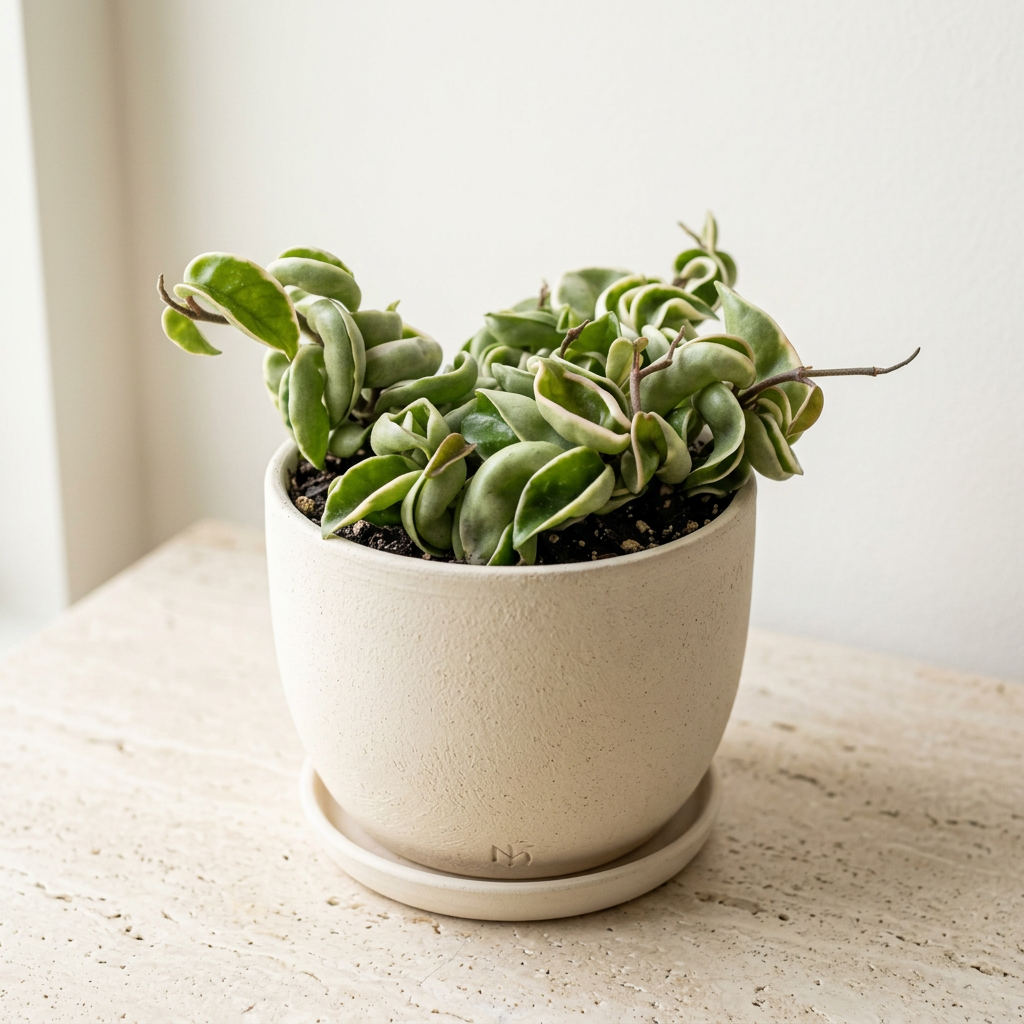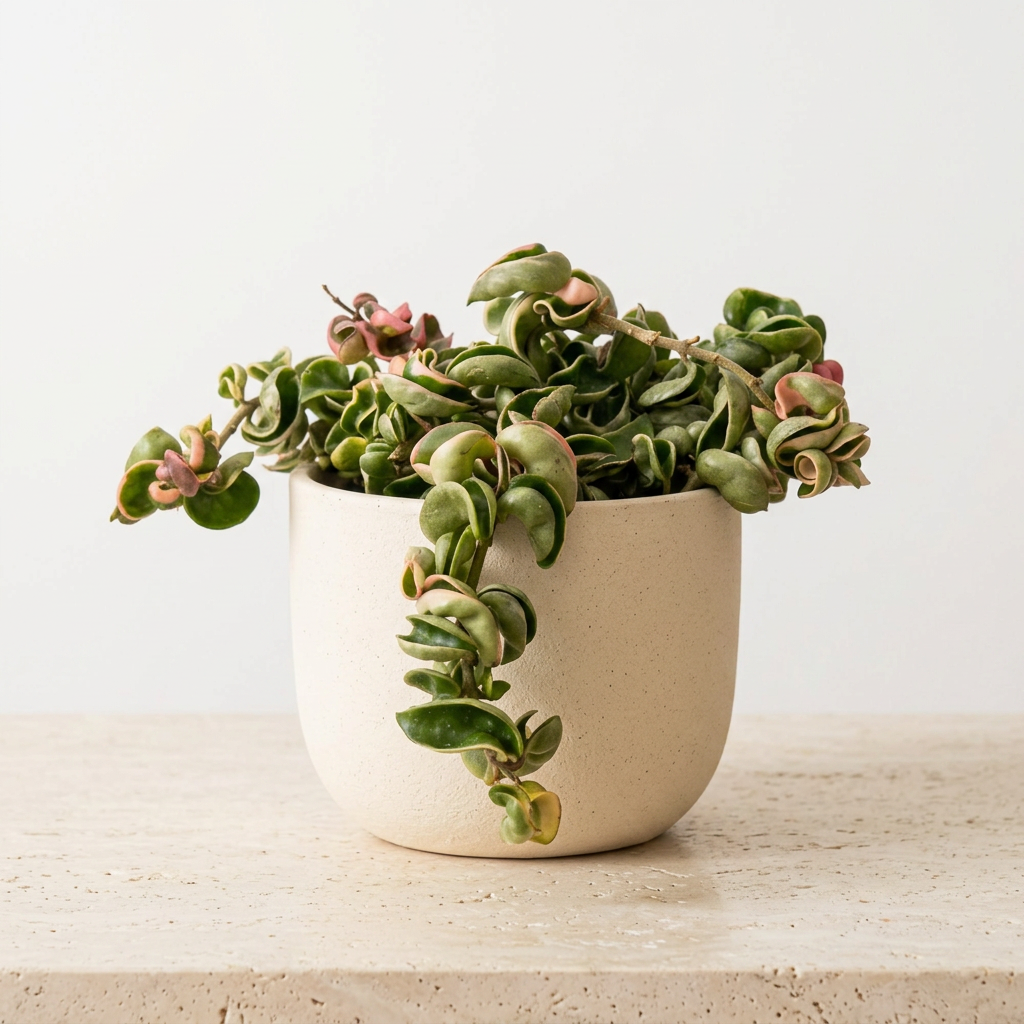


Variegated Hoya Rope Plant Hoya Carnosa Compacta - Pet Safe Non-Toxic Curly Leaf Trailing Houseplant
Variegated Hoya Rope Plant Hoya Carnosa Compacta - Pet Safe Non-Toxic Curly Leaf Trailing Houseplant
Couldn't load pickup availability
Botanical Name: Hoya carnosa 'Compacta Variegata'
Common Names: Variegated Hoya Rope Plant • Variegated Hindu Rope • Krinkle Kurl Variegata • Compacta Regalis • Variegated Wax Plant
The Variegated Hoya Rope Plant (Hoya carnosa 'Compacta Variegata') takes an already strange plant and makes it stranger. The thick leaves fold and curl in on themselves until each vine looks like braided cord, and through that dense twist runs a marbling of cream and white that catches light in a way the solid green form never does. New growth often blushes pink at the tips. There is very little in the houseplant world that looks like it.
This is a plant to buy for what it already is rather than what it will become. Curled leaves and variegated tissue both limit photosynthesis, so it grows slower than nearly any other Hoya, which is exactly why well-grown specimens stay scarce and expensive. In exchange it asks for almost nothing: a bright spot, a snug pot, and water every few weeks. Hoya carnosa is listed by the ASPCA as non-toxic to cats and dogs, so it can hang anywhere in a house with animals.
Complete Care Guide
- Bright, indirect light for 6 or more hours daily, more than the solid green rope form needs
- An east-facing window, or a few feet from a south or west window, is ideal
- Avoid direct sun, which scorches the pale cream tissue long before it touches the green
- In dim light the variegation fades and new growth comes in progressively greener
- Water when the soil is nearly dry throughout (typically every 2-3 weeks)
- The waxy leaves hold a water reserve, so a missed watering does no harm
- Water thoroughly, let it drain completely, and never leave it standing in water
- Cut back sharply in winter, since slow growth means slow water use
- Moderate humidity: 40-60% - appreciates extra humidity but tolerates average rooms
- Temperature range: 60-80°F (15-27°C) with good air circulation
- Keep above 50°F (10°C) and away from cold winter glass
- Airflow matters, as the tightly packed leaves trap moisture and can hold pests
- Use a chunky, fast-draining mix with orchid bark, perlite, and a little potting soil
- Leave it slightly root-bound, since crowded roots encourage flowering
- Feed monthly in spring and summer at half strength, and do not overfeed to force growth
- Repot only every 3 years or so, moving up a single pot size
- Never remove the woody flower spur, as new blooms grow from that exact spot each year
- Trim any fully green vine, which grows faster and will eventually crowd out the variegation
- Trim any fully white vine too, since it cannot photosynthesize and drains the plant
- Check inside the curled leaves for mealybugs, which hide in the folds where they are easy to miss
Styling Ideas for Your Variegated Rope Hoya
Shipping & Potting Information

Frequently Asked Questions
How is this different from the plain green Hoya Rope Plant? ▼
Same species, same tightly curled rope-like vines, with cream and white variegation running through the leaves. The tradeoff is speed and light. Variegated tissue contains no chlorophyll, so this form grows meaningfully slower than the all-green Hindu Rope and needs a brighter spot to hold its coloring. If you want the look with faster fill-in, the solid green version is the easier plant.
Why is my variegated rope Hoya growing so slowly? ▼
This is arguably the slowest common Hoya in cultivation, and there is a real reason for it. Two traits stack against photosynthesis at once: densely curled leaves expose far less surface to light than flat ones, and variegated tissue produces no energy at all. A few inches of new vine across an entire season is a normal, healthy pace here, not a sign that something is wrong.
Why are the cream areas turning brown and crispy? ▼
Pale variegated tissue has no pigment to shield it, so it scorches well before the green does. Brown patches confined to the cream sections nearly always mean the plant is getting direct sun. Move it to bright indirect light, and know that scorched tissue does not recover, though healthy new growth will come in clean.
Why has my plant turned pink or red? ▼
That is sun stress, and plenty of Hoya growers deliberately chase it. In strong indirect light the cream areas blush pink, rose, or coral. It is harmless, reversible, and fades if you move the plant somewhere dimmer. The thing to watch is that you are seeing soft blush color rather than the dry brown patches of genuine sunburn.
Is this plant safe for pets? ▼
Yes! Hoya carnosa is listed by the ASPCA as non-toxic to cats and dogs, and that listing covers every cultivar of the species including this variegated rope form. One practical note unrelated to pets: the milky sap released by cut stems can irritate skin that reacts to latex, so wash your hands after any pruning.
Why is there a limit of 2 plants per order? ▼
Variegated plants can only be propagated from variegated material, and this one grows slower than almost any other Hoya, so every plant on our bench represents years of growing time that simply cannot be rushed. Capping orders at 2 per customer keeps a genuinely scarce plant within reach of more people rather than letting a few large orders clear our stock.